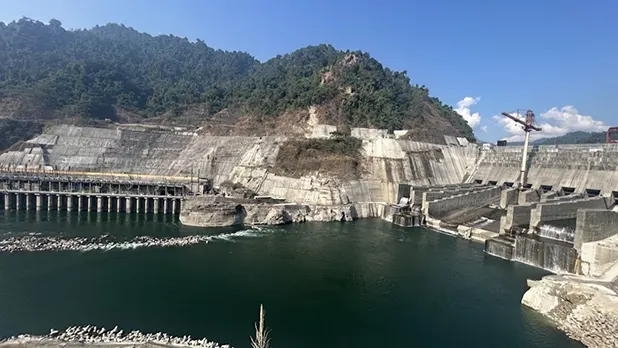
ITANAGAR, 8 May: The NHPC has declared the commercial operation of Unit 4 (250 mw of its 2,000 mw capacity) of the Subansiri Lower Hydroelectric Project (SLHEP).
The unit commenced commercial operations at midnight on 8 May, contributing an additional 250 mw clean energy to the national grid, the NHPC said in a release.
With the commissioning of this unit, the SLHEP has now achieved an operational capacity of 1,000 mw out of its total planned capacity of 2,000 mw, marking a significant milestone in its phased development, the release said.
The PSU said that the project is expected to play a vital role in enhancing grid stability, meeting peak electricity demand, and facilitating the integration of renewable energy into the national grid.
Prior to achieving commercial operation, Unit 4 successfully completed its trial run on 1 May. The remaining units [5 to 8] are planned to be commissioned in a phased manner by the end of this year, the NHPC said.
Upon full commissioning, the project is expected to generate approximately 7,421 million units of electricity annually, contributing significantly to reducing carbon emissions by an estimated seven million tonnes per year, and support India’s transition towards a low-carbon energy future, the release said.
The NHPC began construction of the project in 2005 after receiving forest clearance in 2004. Work on this major project along the Subansiri River came to a halt between December 2011 and October 2019 due to protests in Assam over safety concerns and potential downstream impacts. Following the resolution of all legal challenges raised by the National Green Tribunal, the NHPC resumed construction with certain design modifications starting on 15 October, 2019.
The NHPC stated that the project has been planned and implemented in accordance with statutory requirements and government guidelines, with due emphasis on environmental protection, safety, and socioeconomic welfare.
“Since inception, the project has undergone comprehensive scientific studies, regulatory appraisal and reviews by independent expert committees to address environmental, geological and social concerns associated with large infrastructure projects in the Subansiri-Brahmaputra river system,” it said.
Taking into account the seismic history, hydrological characteristics and ecological sensitivity of the region, the project design incorporates robust safety features, sediment management provisions, and year-round environmental flow releases to maintain downstream river ecology, the release said.
Flood moderation measures have also been integrated, enhancing downstream safety during monsoon periods and contributing to basin level resilience.
The social impact of the project has been minimised, it said.
No habitations are being submerged, and the limited agricultural land affected is being addressed through rehabilitation and compensation in accordance with the Arunachal Pradesh Rehabilitation and Resettlement Policy, the NHPC said.
“Further, compensatory afforestation is being undertaken over a substantially larger area of degraded forest land in Arunachal Pradesh and Assam through CAMPA funds. To further safeguard downstream areas, riverbank protection works, real-time flood forecasting and early warning systems have been established. Project operations are supported by advanced monitoring and control systems to ensure safe and regulated functioning,” the release said.
It also stated that sustained investments have been made in community development through livelihood support, education, healthcare, drinking water facilities, skill development and other socioeconomic initiatives in project-affected and nearby areas of Arunachal and Assam.
Power generated from the project is equitably shared, with free power benefits accruing to the host states and improved clean energy availability for the wider region.
“The project thus reflects an integrated approach to development, combining national energy security with environmental responsibility and inclusive growth,” the release added.