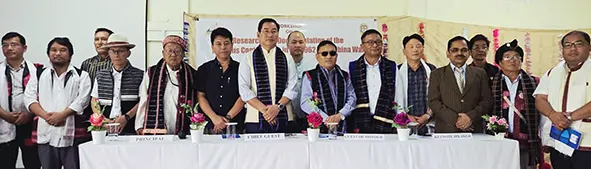
TEZU, 30 Apr: The history department of Indira Gandhi Government College (IGGC) here in Lohit district organised a workshop on ‘Research and documentation of the Mishmi community’s contributions during the 1962 Indo-China war’ on Thursday.
Speaking on occasion, IGGC Principal Dr Kangki Megu said that the narrative of 1962 “is incomplete without acknowledging the contributions of Mishmi and Meyor communities.” He lauded their unwavering bravery and sacrifice, noting that their intimate familiarity with the rugged terrain and their logistical support were instrumental during the conflict to prevent the Chinese aggression at Walong in 1962.
Political Science Associate Professor Dr PC Swain delivered the keynote address, critiquing the traditional omissions in regional and national historiography. He pointed out that mainstream history has largely overlooked the bravery and gallantry of the Mishmi and Meyor people during the Sino-India war of 1962.
Dr Swain urged local experts and researchers to transcribe oral histories and collaborate closely with the Indian Army to validate data.
Lohit Deputy Commissioner KN Damo reflected on the era of ‘Hindi-Chini Bhai-Bhai’, noting how the betrayal of that sentiment led to the intrusion into Indian territory. He credited the Mishmi community with the historic stalemate at Walong, asserting that their support forced Chinese troops to hold their positions.
Local MLA Dr Mohesh Chai commended the union Culture Ministry and Prime Minister Narendra Modi for launching nationwide programmes to recognise the unsung heroes of the war. Dr Chai reminded the audience of legendary figures like Matmur Jamoh, Moji Riba, and Taji Dele, and encouraged the students to delve deeper into their legacies. He spoke about the Battle of Walong, where the Mishmi and Meyor communities fought in tandem with the Indian Army to protect the motherland.
Other dignitaries who spoke on the occasion were retired IAF group captain Mohanto Panging Pao, Leche Molo, Mayeso Pul, Tashi Tsering Meyor, Drengso Pul, and Shivumso Chikro.
The workshop was attended by more than 150 students of IGGC’s history department, faculty members, gaon buras, and intellectuals of Mishmi and Meyor communities.