[ Tayi Taggu ]
Tawang boasts a rich history as a key Buddhist centre, the homeland of the Monpa people, and the birthplace of the 6th Dalai Lama (Tsanyang Gyatso). It is famous for high-altitude tourism, with the historic Tawang monastery – founded in the 16th century – being India’s largest and drawing many visitors. The name ‘Tawang’ translates to ‘the place chosen by the horse,’ where ‘Ta’ means horse and ‘Wang’ indicates chosen, blessed, or empowered.
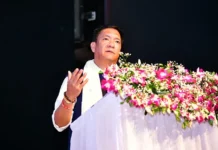
The deputy commissioners’ conference was held at VIVANTA in Tawang from 9 to 11 April, and was led by Chief Minister Pema Khandu, Deputy Chief Minister Chowna Mein, and Chief Secretary Manish Gupta. The event ran smoothly from 9 am to 6:30 pm, with a 10-minute tea break and a 30-minute lunch.
Deputy commissioners are crucial to implementing government policies and programmes, and in providing services directly to citizens. The focus shifted from academic debates to transforming governance through improved real-time service delivery. Topics covered included urban expansion, planned development, and land record digitisation through the Digital India Land Record Modernisation Programme (DILRMP), along with related challenges. AI has become integrated into daily life, with applications in healthcare, finance, transportation, education, and entertainment.
Emphasis was placed on human resource development, comprehensive education for students, and training teachers for future needs. The significance of health and alternative medicine practices, such as yoga and meditation, was also underscored.
The state aims to boost micro, small, and medium enterprises (MSMEs) to foster economic growth while protecting forests, wildlife, and the environment. Efforts continue to position Arunachal as a leading tourism hub. Additionally, Prime Minister Narendra Modi’s Gyan Bharatam Mission seeks to preserve and promote India’s intellectual heritage – including science, philosophy, mathematics, and medicine – while encouraging research in yoga, Ayurveda, and Sanskrit, as well as digitising manuscripts and traditional knowledge.
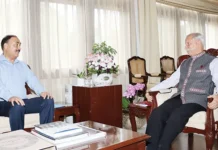
The presence of VVIPs at the conference, including the Governor KT Parnaik, union Parliamentary Affairs Minister Kiren Rijiju, MP Tapir Gao, and ministers Nyato Dokum and Kento Jini, underscoredthe government’s commitment to good governance.
All roads lead to Tawang for a good reason. Its charm draws visitors, including sports enthusiasts, students, officials, VVIPs, and tourists. Many feel it’s like returning home, as locals warmly welcome tourists, private visitors, and officials. The number of homestays is rising, with improved interiors and exteriors that attract travellers. Tourism can be profitable, but its success depends on people’s attitudes, warm hospitality, quality accommodation, and natural beauty that encourage visitors to return. Tawang remains a central hub of Arunachal Pradesh’ tourism, and a key destination. Over the past decade, road infrastructure has improved significantly, especially with the Nechiphu and Sela tunnels, developed under Prime Minister Narendra Modi and Chief Minister Pema Khandu.
Khandu, a young, dynamic, and visionary leader, has significantly promoted tourism and overall development in the state. His leadership has resulted in achievements such as establishing the Staff Selection Board, improving manpower recruitment, and strengthening public services. His contributions are evident everywhere, and Arunachal’s future aligns with the goals of Viksit @Arunachal and Viksit Bharat @2047.
In Tawang, a well-built concrete road runs smoothly through the town, unlike many rough, uneven roads elsewhere in Arunachal. While fair distribution of funds is crucial, how these funds are used ultimately determines the outcomes.
The author once challenged a contractor who intentionally did shoddy work, saying, “Sir, your actions are immoral.” The contractor replied calmly, “Sir, what will I do next March if this work isn’t damaged?” This attitude is risky, and I was surprised to see that laws alone can’t stop such behaviour without penalties. The main challenge now is to ensure proper execution and efficient use of the allocated funds.
Why do most tourists avoid exploring the so-called Abu Tani belt from East Kameng to Lower Dibang Valley, except for the Ziro plateau? Locals often approach tourists with curiosity, questioning them like investigators. At first, we may seem unfriendly, but later we show warmth and hospitality. Tourists usually prefer to be left alone without much interference. Although our natural demeanour isn’t unfriendly, old habits linger. Sometimes, tourists’ cameras are snatched, and money is demanded, spoiling their travel experience. Every society has its black sheep, and these behaviours reflect our attitude towards tourism. Remember, word of mouth is more influential than advertising, and first impressions shape visitors’ perceptions. This is where we failed.
Tawang’s history is incomplete without mentioning Major Ralengnao Bob Khathing, a Tangkul Naga from Manipur. He was a versatile individual appointed by Jairam Daulat Ram, then-governor of Assam, on the advice of Sardar Vallabhbhai Patel. His task was to incorporate Tawang into India following the 1914 Simla Agreement. An exceptional Indian Army officer, he organised and led an expedition, negotiated with local Monpa leaders to ease their fears, assumed administrative control, and peacefully secured Tawang. His diplomatic, peaceful, and strategic approach successfully integrated Tawang into India, where the national flag was raised on 14 February, 1951. His clear message was that Tawang would no longer face unfair taxes from Tibetan officials, as it was now part of India.
Historically, Monpa communities suffered humiliation, beatings, and starvation due to heavy taxation. His legacy might have been forgotten if not for Azadi Ka Amrit Mahotsav and India’s Unsung Heroes initiative led by Prime Minister Narendra Modi and Chief Minister Pema Khandu, who ensured recognition of Major Khathing’s importance.
To make Arunachal a progressive state, we need capable leaders who can envision and implementfuture plans. While disciplining unruly bureaucrats is possible, genuine leadership reflects the will of the people, the supreme authority in our democracy. Building a strong economy is essential, but protecting our culture, traditions, heritage, and roots is equally important as we move forward. Our collective efforts should focus on defining progress in terms of compassion, happiness, prosperity, and accountability.
Tawang’s breathtaking landscapes, sacred traditions, rich history, and warm hospitality exemplify sustainable development. Through visionary leadership and community collaboration, Tawang can serve as an inspiration for the entire nation. We hold the power to shape our destiny. As Abraham Lincoln remarked, “The best way to predict your future is to create it.” (The contributor is Deputy Commissioner, Siang district)