ITANAGAR, 2 Dec: Governor KT Parnaik on Tuesday underscored the urgent need for a state-specific geospatial and AI-driven platform to strengthen governance, accelerate development planning, and enhance the security architecture of the frontier state.
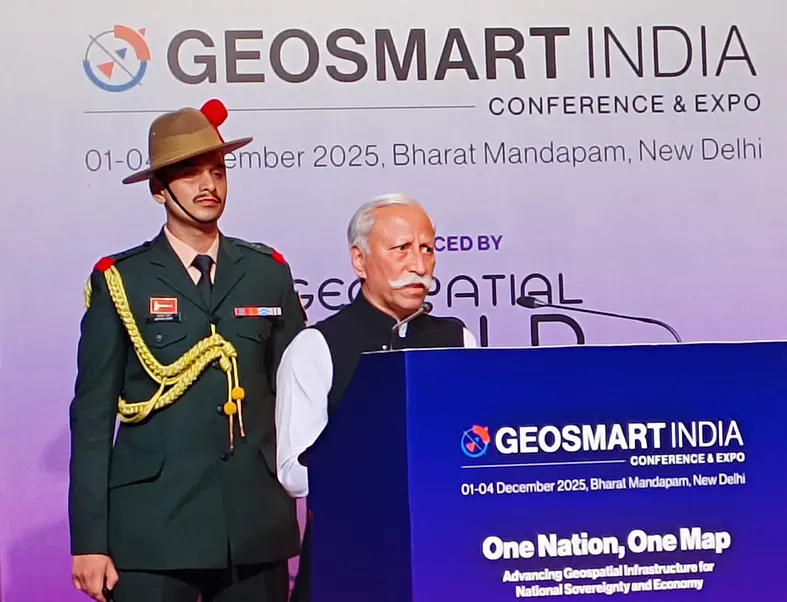
Speaking at the GeoSmart India conference in New Delhi, the governor said that advanced geospatial tools, ranging from GIS and GPS to drones, satellite imagery and digital mapping, must be fully integrated into policymaking to ensure evidence-based, transparent and future-ready governance.
Participating in the Northeast conclave of the four-day conference themed ‘One Nation, One Map’, Parnaik said geospatial technology has become indispensable for smart decision-making, a Raj Bhavan communiqué said here.
He noted that these tools strengthen the developmental process by precisely mapping terrain, resources and infrastructure gaps, enabling planners to identify ideal locations for roads, bridges and public services while aligning projects with community needs and environmental conditions.
Highlighting the role of geospatial monitoring, Parnaik said it increases transparency by tracking land use, forests, water bodies, crop patterns and project progress in real time, thereby allowing timely corrective interventions.
Such technologies, he said, facilitate scientific assessment of natural resources, climate trends, biodiversity and socioeconomic patterns, supporting long-term planning.
The governor further stated that geospatial analysis helps assess feasibility, risks and environmental sensitivity before major projects begin, reducing disputes and cost overruns.
He proposed several measures, including a state-level geospatial policy, a central data repository, GIS training for government teams, interdepartmental integration of datasets, drone-based mapping, and dashboard-based public monitoring.
Parnaik also emphasised that geospatial technologies can significantly improve disaster preparedness by identifying landslide-prone belts, flood pathways and vulnerable settlements while enabling quick, targeted responses.
They also strengthen environmental protection through tracking of forests, wildlife corridors and river systems; support agriculture by identifying suitable zones for crops like kiwi, orange and apple; and improve both urban and rural development through better land records, drainage planning and asset management.
The tools, he said, also assist in border management and promote sustainable tourism by mapping trekking routes, cultural sites and ecotourism zones.
The governor said that mapping natural resources and renewable energy potential will be key to long-term sustainability, making geospatial tools central to the state’s development and good governance.
Referring to his recent review of PM GatiShakti implementation in the state, Parnaik acknowledged the platform’s value in tracking welfare schemes and infrastructure projects.
However, he stressed that Arunachal Pradesh must “take a step further” by developing an AI-powered, state-specific application tailored to local geography and administrative needs.
“Such an integrated dashboard accessible across departments will streamline coordination, prevent duplication of efforts, enhance transparency and accelerate decision-making,” he said.
Underlining its security implications, the governor said the proposed platform would strengthen monitoring along the state’s long and remote borders. It could map drug-trafficking routes with greater precision, support continuous surveillance, fuse intelligence in real time, and improve interagency information-sharing, he pointed out, adding that it would also aid asset tracking and seizure operations, empowering security forces to respond swiftly and decisively.
Parnaik added that such technological integration would ultimately help safeguard the youth, protect communities, and enhance governance efficiency across Arunachal. (PTI)