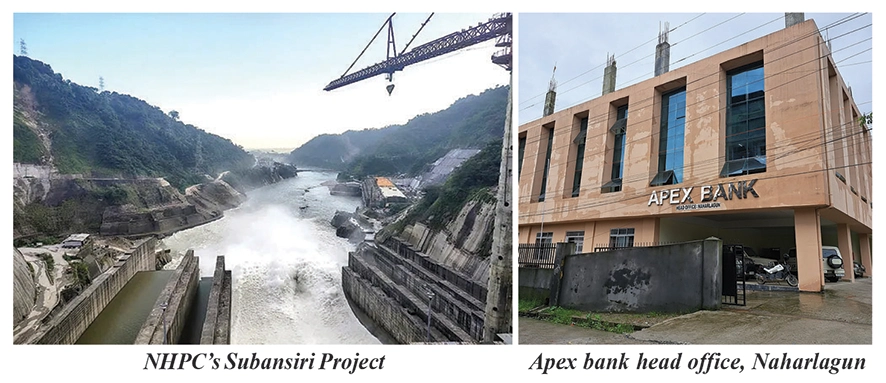
[ Tongam Rina ]
ITANAGAR, 16 Dec: In 2007, Chief Minister Dorjee Khandu’s government took an advance of Rs 225 crore from the National Hydroelectric Power Corporation Limited (NHPC).
Because of the advance, the state is burdened with a debt exceeding Rs 1,000 crore, which continues to accrue compound interest at 9% per annum on the advance taken nearly 18 years ago.
The government had then stated that an advance was taken from NHPC to revive the Arunachal Pradesh Cooperative Apex Bank Limited.
Since its inception in 1978, the bank has primarily been known for various frauds and irregularities committed by its officials, and politicians, with little accountability.
The Rs 225 crore advance was secured against the Dibang Multipurpose Project (3,000 mw) and Tawang Stage-I & II (600 mw and 800 mw), with the intention of covering the debt through the free power the state was to receive from the 2,000 mw Subansiri Lower project.
However, Tawang remains stalled due to local protests, and Dibang has faced delays for years due to similar issues. The proposal to finalise the sale of free power from the Subansiri Lower project was discussed at the Operational Sub-Committee (OCC) of the North Eastern Regional Power Committee (NERPC), Ministry of Power, held in November in Guwahati. Arunachal proposed that the NHPC recover or adjust the advance by selling the entire free power it would receive from the Subansiri Lower project. According to the proposal, there would be no power left for local consumption, as the NHPC would sell the state’s share to recover the advance.
The Uttar Pradesh Power Corporation Limited (UPPCL) and the Tripura State Electricity Corporation Limited (TSECL) have given their consent to procure Arunachal’s 12% share of free power at the CERC-determined tariff, according to the document. Corresponding power purchase agreements (PPAs) have been executed with both the UPPCL and the TSECL. The UPPCL will purchase 215 mw, while Tripura will purchase 25 mw.
“In the original allocation order, 12% of the free power (including 1% for the local area development fund) was earmarked for the Government of Arunachal Pradesh. Further, as per the memorandum of agreement (MoA) signed between Arunachal Pradesh and NHPC on 24 June, 2007 for the execution of Tawang-I, Tawang-II, and the Dibang Multipurpose Project, the NHPC advanced Rs 225 crore to the Government of Arunachal Pradesh. The MoA authorises the NHPC to sell the free power on behalf of the state to recover the advance amount, with compounded interest at 9% per annum, from the first project commissioned in the state, including the Subansiri Lower HEP, at the CERC-determined tariff.
Subsequently, the state government, via a letter dated 4 March, 2025, requested the NHPC to sell both 11% of the free power and 1% of the LADF power at the CERC-determined tariff,” according to the official document.
Tripura has raised concerns over the tariff, noting that it has increased significantly since the signing of the power purchase agreements, due to substantial delays in the project’s execution. The rise in tariff has been referred to a committee for further discussion.
Launched in January 2005 at Gerukamukh on the Arunachal-Assam border, the Subansiri project faced an eight-year suspension (2011-2019) due to protests by Assam-based organisations and legal challenges. The cost of the project has increased from Rs 6,285 crore (as estimated in 2002) to approximately R s 26,000 crore in 2025 due to these delays and technical hurdles.
However, after years of delay and escalating costs, the Subansiri power project is now back on track, with full commissioning expected in 2026-27. While safety concerns remain, as well as violations of environmental rules, the mechanical run of the first 250 mw unit has been successful, and synchronisation with the national power grid for another 250 mw is in progress.
“The NHPC plans to commission three additional 250 mw units within this year, adding 1,000 mw to the national grid. Once fully operational, the eight-unit (8 x 250 mw) project will generate 2,000 mw, making it India’s largest hydroelectric facility,” according to official records.