ROING, 19 Dec: Deputy Chief Minister Chowna Mein emphasised the critical need for preserving ancient manuscripts through proper documentation and digitalisation, noting that the Research Institute of World’s Ancient Traditions, Cultures and Heritage [RIWATCH] can play a pivotal role in this preservation effort.
Mein said that the cultural history of the indigenous people of Arunachal Pradesh must be comprehensively written and made accessible to wider audiences, both within and outside the state.
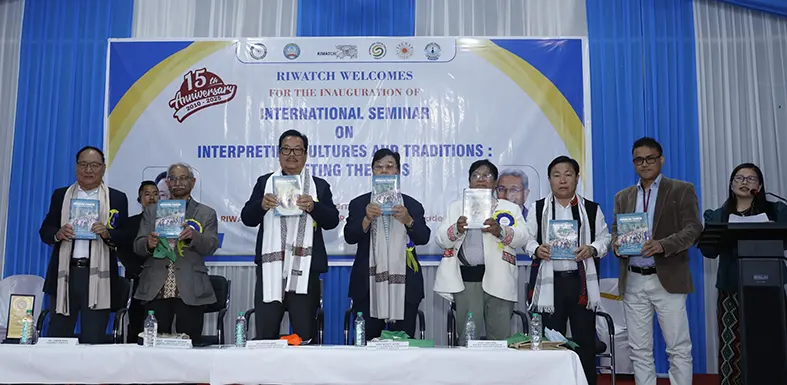
Inaugurating an international seminar titled ‘Interpreting cultures and traditions: Shifting the lens’ at the RIWATCH here in Lower Dibang Valley district on Friday, Mein stated that events like this seminar could contribute immensely towards this goal. He called for the creation of positive narratives around indigenous cultures and traditions that celebrate their richness and resilience.
Mein highlighted multiple critical issues facing Arunachal. He noted that Arunachal still lacks its own comprehensive cultural and political history, emphasising the urgent need to develop such a narrative.
Mein also called for an immediate action on the declining animal and bird species in the state. “It is high time to conserve the biodiversity that once formed an inseparable part of the natives’ culture and tradition,” he said.
Mein warned that, without concerted efforts, the future generations would miss out these species and the cultural practices associated with them.
Arunachal Pradesh University Vice-Chancellor Prof Tomo Riba presented a sobering assessment of the current state of indigenous knowledge systems. He observed that native traditional culture and knowledge are vanishing at an alarming rate, with rural depopulation emerging as the primary reason for the loss of cultures, traditions, and indigenous knowledge systems.
Prof Riba said that traditional knowledge related to agriculture and house construction is gradually disappearing due to the easy accessibility of modern, sophisticated materials and technologies. He emphasised the urgent need to preserve the richness of indigenous terms and terminologies, and to ensure their continuity for future generations.
He also issued a strong warning against the commercialisation of traditional practices, particularly festivals. He stressed that indigenous celebrations should serve as platforms for celebrating and showcasing cultural identity, “rather than becoming barriers to participation or being reduced to mere commercial spectacles.”
Prof Yashwant Pathak, dean of faculty affairs at the University of South Florida, USA, provided a historical analysis of how colonial infrastructure systematically dismantled indigenous cultures and traditions worldwide.
Drawing from the devastating example of the native American experience, he explained how colonial invasion led to the vanishing of millions from the indigenous population.
Prof Pathak elaborated how the imposition of new narratives and thought processes derived from Western ideologies resulted in the extinction of ancient traditions around the world.
He argued that at this critical juncture, where Western and Eurocentric influences continue to dominate global discourse, “there is an urgent need for a fundamental shift in the lens.”
“This shift must enable us to view indigenous cultures from our own perspectives and empower native communities to build and preserve their ancient cultures and traditions through their own sustained efforts, free from external imposition or interpretation,” Dr Pathak added.
RIWATCH patron Mukut Mithi provided a philosophical framework for understanding the seminar’s significance. He described the organisation of such an academic event as both timely and profound, given the existential threats facing indigenous cultures globally.
Mithi emphasised that culture must be studied with empathy, suggesting that academic rigour alone is insufficient without a genuine emotional and ethical commitment to the communities being studied. He stated that beyond research and documentation, the protection of cultures and heritage through the active involvement of native communities should be a primary aim of institutions like the RIWATCH.
Mithi noted that the development of any native culture should not be measured by its technological advancement but rather by its cultural wisdom and the depth of its traditional knowledge systems.
Earlier, RIWATCH Executive Director Vijay Swami emphasised the objective to interpret cultures and traditions from the natives’ perspectives, marking a crucial shift in how indigenous knowledge systems are understood and documented.
The seminar will continue until 21 December, and feature an academic programme comprising five plenary sessions exploring various themes related to interpreting cultures and traditions from indigenous perspectives. A total of 44 research papers are being presented by academicians and scholars from various parts of India and abroad, making it a truly international platform for discourse on indigenous cultures, traditional knowledge systems, and the challenges of cultural preservation in the modern era.
The seminar is being organised by the RIWATCH in association with Maulana Abul Kalam Azad Institute of Asian Studies, Rajiv Gandhi University, the International Centre for Cultural Studies, the Arunachal Pradesh University, and the Indigenous Faith and Cultural Society of Arunachal Pradesh.