[ Pisi Zauing ]
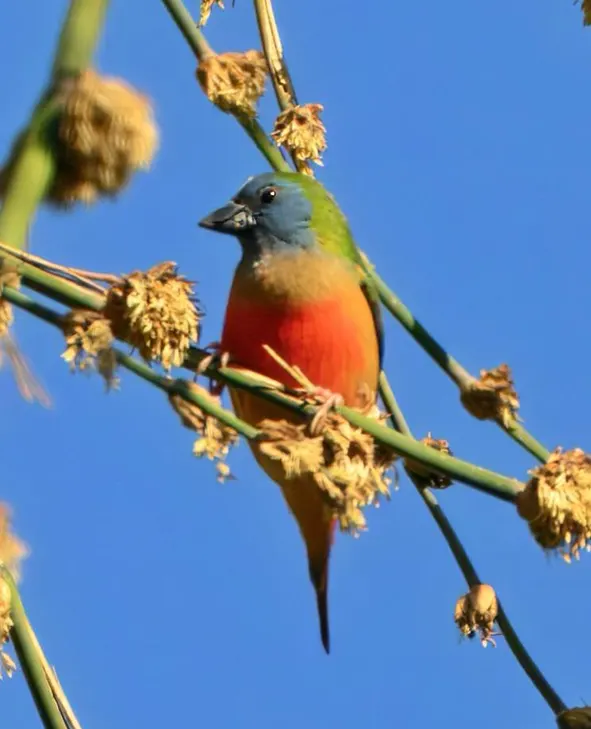
DEBAN, 9 Jan: A flock of pin-tailed parrotfinch was sighted in the Namdapha National Park & Tiger Reserve in the morning of 6 January.
The sighting is the first ever record of this species in Arunachal Pradesh and probably the second for India.
A team of birders comprising guide Binanda Hatibaruah, Lt Gen Bhupesh Goyal, Mistu Basu and Vinod Gupta spotted a flock of white-rumped munias- a common bird for this area, feeding on bamboo flowers – at 62 Mile on the Miao-Vijaynagar road while returning from their birding expedition to Gandhigram-Vijaynagar area. Goyal sighted a couple of unusual birds in that flock with orangish-red belly.
Team leader Hatibaruah confirmed that the birds were indeed a new species for this region and asked the team members to take as many pictures as possible for identification later. He soon discovered that the ‘unusual’ birds were pin-tailed parrotfinches.
There were two males and two females, all feeding aggressively on bamboo flowers, like the munias. They stayed on that flowering branch for nearly 30 minutes before moving on.
This species is usually found in many South East Asian countries such as Borneo, Indonesia, Vietnam, Laos, Cambodia, Malaysia and Thailand, and has been seen as far west as Myanmar.
The first photographic record of this species for India was made in Reiek, Mizoram in April 2025, where it was feeding on bamboo flowers along with munias.
It has been described as a ‘ghost bird’ by eBird. It suddenly appears in large flocks when paddy harvest or bamboo flowering is ready, devours the crops or the bamboo flowers and then vanishes, only to reappear when the next bamboo flowering or rice crop is ready for harvest.
The male of this beautiful species is leaf green with a blue face and reddish belly and pointed long tail, giving it an overall size of 15 cm. The female, on other hand, has a faded blue face and faded green on its upper parts and lacks any red colour on its belly. With a shorter tail, it is about 12 cm in size.
With more people taking up birding as a hobby and profession, more eyes are looking out for birds. As a result, more new species are being added to the Indian avifauna.
“We are hopeful that there will be more sightings of this bird in India in the future as well, especially in the states bordering Myanmar. Just look out for this bird every time the bamboo flowers. They seem to love bamboo flowers,” Lt Goyal said.