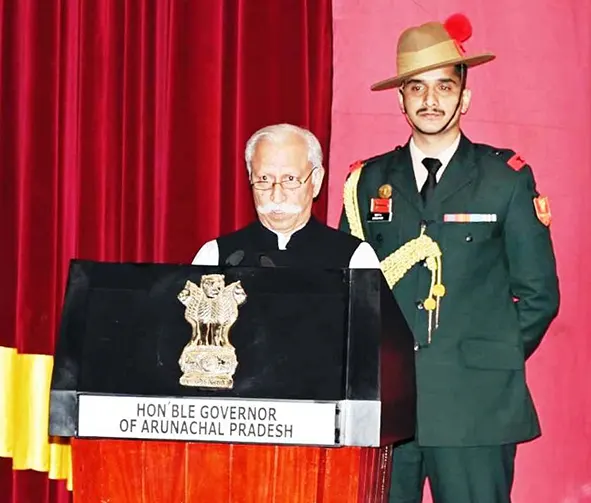
WELLINGTON, 30 Jan: Arunachal Pradesh Governor KT Parnaik said that over the past decade Arunachal has emerged as a vital pivot of India’s Act East policy and the collective vision of a Viksit Bharat.
The governor said this in his keynote address on the topic ‘Arunachal Pradesh and the emerging Northeastern security paradigm’ during a seminar themed ‘India’s eastern horizons – A new national security reality’ at the prestigious Defence Service Staff College (DSSC) here in Tamil Nadu on Friday.
The governor, who had 41 years earlier attended the Staff College course as a major, highlighted the remarkable transition and accelerated development of Arunachal, and observed that unprecedented investments in connectivity have transformed the landscape, with over 4,000 kilometres of roads built in the last five years alone, reaching remote and border areas and bringing governance and essential services closer to the people.
He added that the steady expansion of rail and air connectivity has further strengthened Arunachal’s integration with the rest of the country, unlocking new opportunities for mobility, trade, tourism, and swift emergency response.
Addressing the DSSC faculty members and 500 student officers, including 44 international student officers from 35 nations of the 81st staff course, the governor also highlighted that unstable situations in neighbouring countries – Myanmar and Bangladesh – do not bode well for the Northeast region. “They are impacting India in an adversarial manner and need to be addressed through diplomatic, political and economic efforts,” he said.
The governor said India’s Northeast is an important region which needs to be developed. He observed that the Northeast is uniquely shaped by its rich geography and diverse ethnic communities whose cultural and social ties naturally extend across neighbouring countries.
Exposing the future military leaders to strategic issues both at the global and national levels, the governor said the security dynamics of the Northeast region are shaped by a complex and multidimensional interplay of external influences, internal ethno-political realities, and an intricate mix of local politics and insurgent movements. He said that these challenges cannot be viewed in isolation, as they are deeply intertwined with one another and evolve over time.
Parnaik said that the situation is rooted in historical grievances, trans-national tribal linkages, and porous international borders, “all of which add layers of sensitivity and complexity to the region’s security landscape.”
Addressing these issues, he emphasised that the situation requires a nuanced, inclusive, and people-centric approach that balances security concerns with dialogue, development, and respect for the region’s unique social fabric.
Highlighting the ground realities of the entire Northeast region, the governor outlined a clear and forward-looking vision for addressing future security and developmental challenges. He suggested that the way forward lies in adopting comprehensive and well-coordinated measures that are rooted in both strategic foresight and an understanding of the region’s unique social and geopolitical context.
Drawing from his experience of having served in the NE region, and his firsthand exposure to militancy in various parts of the country, the governor underscored that “enduring peace cannot be secured through isolated measures.” He stressed the need for a “whole-of-the-nation approach, anchored in clear strategic vision, seamless political and governance integration, and the strengthening of economic and industrial capacities.”
Highlighting the changing nature of security challenges, he pointed to the growing importance of technology and the cyber domain, alongside the imperative of fostering societal resilience and ensuring robust internal security. The governor observed that only a unified national effort, bringing together institutions, agencies, communities, and stakeholders, can deliver lasting peace, stability, and inclusive growth in the region.
The Defence Service Staff College in Wellington is an institute of international repute, imparting professional military education to selected officers of the armed forces of India and those of friendly foreign countries with the aim of honing their skills for tenanting higher ranks in the future. (Lok Bhavan)