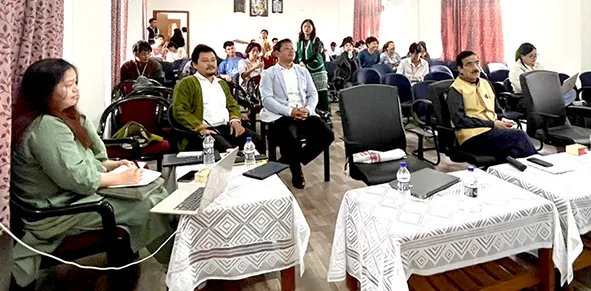
ITANAGAR, 28 Apr: Dera Natung Government College(DNGC) here organised a workshop on ‘AI-motivated personality development skills’ on Tuesday.
Centred around the theme, ‘The art of communication is the language of leadership’, the workshop aimed to equip the participants with essential communication and personality development skills in the age of artificial intelligence (AI).
Addressing the participants, DNGC Principal Dr MQ Khan highlighted the college’s commitment to academic excellence and holistic development, emphasising its consistent performance, active departmental contributions, and strong results. He underscored the importance of initiatives such as career counselling and skill-based programmes in enhancing students’ growth and employability.
Lauding the operational efficiency and proactive faculty contributions, he noted that the event’s success -evidenced by robust student participation despite the examination season – reflected the college’s dedication to equipping students with essential, AI-aligned communication and personality skills in an increasingly competitive global landscape.
Session 1, titled ‘Introducing communication skills: The linchpins with AI tools’, was conducted by New Delhi-based Jamia Hamdard University’s English Assistant Professor Sanya Khan. The session explored the evolving communicative environment in the age of AI, highlighting key concepts such as the KOPPACT factor, active listening, effective speaking, and the role of ice-breakers in sustaining conversations.
Communication was described as a set of essential “linchpins” that enable meaningful interaction across contexts, with AI tools like GPT positioned as supportive technologies that process and generate human language rather than replace human communicators. Emphasis was placed on understanding both the advantages and limitations of AI, including issues of linguistic bias, accessibility, and the need for institutional support for effective implementation.
The KOPPACT framework – covering kinesics, oculesics, paralanguage, proxemics, chronemics, haptics, and artifactics – was introduced as a comprehensive model of non-verbal communication. The session also underlined core communication skills such as empathy, clarity, conflict resolution, and adaptability.
Session 2, titled ‘Presentation & interaction: Not what you say, but how you say it’, was conduced by DNGC English Associate Professor Nending Ommo. The session emphasised that effective communication depends not only on words but significantly on delivery-tone, pitch, modulation, body language, confidence, and emotional expression.
Communication was explained as comprising two parts: content (what is said) and delivery (how it is said), with delivery shaping interpretation and impact. Key elements of effective presentation included voice tone, facial expressions, clarity, presence, and the avoidance of fillers. The session highlighted how delivery influences first impressions, emotional connection, persuasion, and leadership.
Several theories were introduced to support this idea, including Mehrabian’s Communication Theory, Aristotle’s Rhetoric (ethos, pathos, logos), Nonverbal Communication Theory, paralinguistics, Social Presence Theory, Expectancy Violations Theory, Emotional Intelligence Theory, transactional model, impression management, and Cognitive Load Theory.
Together, these frameworks reinforced that communication effectiveness is deeply tied to how messages are expressed and perceived.
The session also introduced AI-based tools such as Orai, Speeko, Yoodli, ELSA Speak, Gamma, Canva, ChatGPT, and Google Gemini for improving communication skills. It concluded that while words provide meaning, it is delivery that transforms communication into impact, making it essential for effective speaking and leadership.
Session 3, on ‘Communicating your way to success: From social to digital leadership’, was conducted by Pasighat (E/Siang)-based Arunachal Pradesh University’s English HoD Dr Razzeko Delley. The session focused on communication as a foundation for leadership, success, and societal influence in both social and digital spaces.
Key areas included smart goal-setting, building relationships (including public relations and clientele management), effective use of social networks and media for communication and marketing, as well as group dynamics, conflict resolution, and the development of core skills such as creativity, critical thinking, and problem-solving.
A major theme of the session was language power, highlighting language as more than a communication tool, as it shapes thought, identity, culture, and reality. It was discussed in relation to human evolution, emphasising its biological and cognitive foundations and its role in survival, social organisation, knowledge transmission, and cultural development.
The session further explored the relationship between language and power in society, including political, social, and ideological dimensions, drawing on thinkers like Michel Foucault. It also examined how language constructs identity, preserves knowledge, and enables expression in literature, art, and digital communication. The role of language in social media and global communication in the modern context was emphasised, along with its potential to influence, inspire, or manipulate.
Additionally, the importance of writing, reading, and speech was highlighted as three pillars of communication. Writing was described as a lasting tool for shaping ideas and preserving knowledge, reading as a means of intellectual growth and transformation, and speech as a powerful medium for persuasion and inspiration.
The session concluded by reinforcing that mastery of language empowers individuals to think critically, communicate effectively, and actively participate in shaping society.
Session 4, on ‘Communication skills 3: Visual communication’, was conducted by DNGC English Assistant Professor Goli Nyodu. The session explored visual communication as a key aspect of modern communication, focusing on visual culture, perception, aural communication, body language, and facial expressions.
His presentation explored communication in the contemporary digital age, focusing on the interplay between visual culture, perception, oral communication, body language, and artificial intelligence. He highlighted how today’s image-driven world often communicates faster and more powerfully through visuals, while meaning is ultimately constructed by the viewer, based on experience, culture, and context.
A key insight was the subjectivity of perception, where the same message can be interpreted differently by different individuals. He noted that miscommunication often arises not from language but from differences in perception, making clarity and awareness essential, especially in leadership communication.
The session also emphasised the importance of oral communication, where tone, pitch, pace, and pauses shape meaning, along with non-verbal cues such as body language and facial expressions, which often carry greater impact than words. Prof Nyodu dwelt on the growing influence of artificial intelligence in visual culture, where AI now analyses and generates human-like communication, raising concerns about authenticity and perception.