[ Dojum Mara ]
Deep inside the silent forests of Lower Siang district, where mist clings to ancient trees and history lives more in memory than in books, a forgotten legacy has stirred back to life.
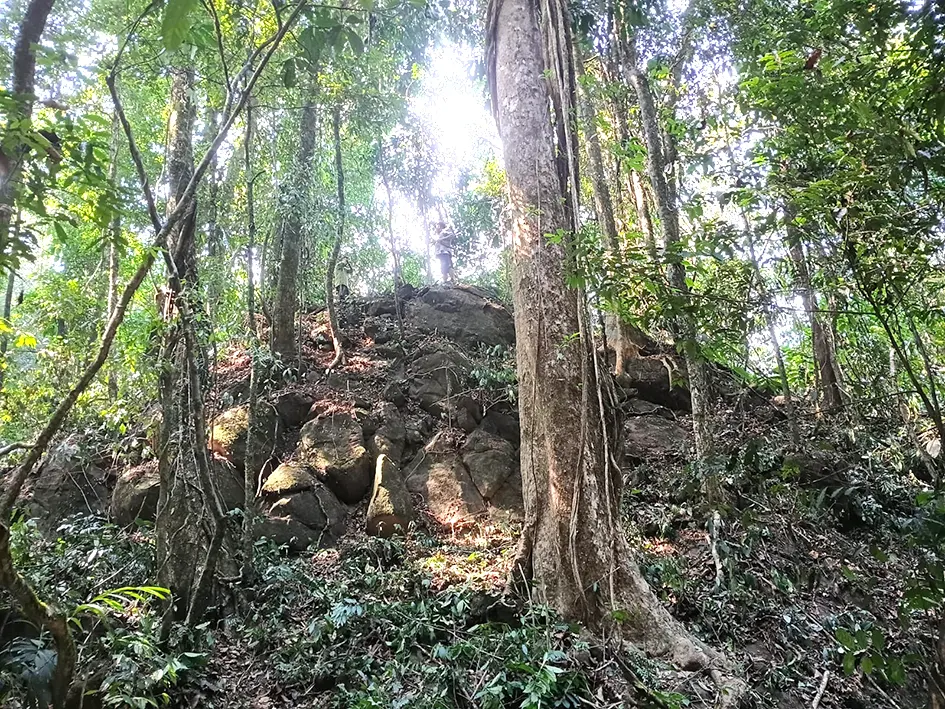
Guided not by maps but by ancestral whispers, oral traditions, cultural memory, and youthful determination, members of the Bomar-Mara community have discovered a long-lost stone mound deep within the forests of Kerri Mori mountain in Lower Siang district, believed to be the memorial of their revered ancestor Ato Ginlo.
What they uncovered was not merely a stone mound but a powerful reminder of sacrifice, identity, and an unbroken link to a warrior ancestor whose bravery once shaped history beyond the hills.
Community elders recount that “the ancestors whispered, the forest listened, and the Mara found their way.” After two relentless expeditions through dense and difficult terrain, Bomar-Mara youths finally located the large stone mound hidden deep in the forested hills. The discovery is being hailed as a major cultural and historical milestone for the community.
The discovery of Ato Ginlo’s memorial is more than an archaeological find – it is a cultural awakening. It reconnects the Bomar-Mara community with a past forged in courage and loyalty, and with a broader history that once linked their ancestor to the Ahom kingdom under Ahom king Sorgo Denlakshmi Singha, a ruler remembered for his resilience during one of the most turbulent chapters of Ahom rule in the 18th century.
Despite facing internal unrest during the Moamari rebellion, the king upheld the tradition of honouring with a dodin potta (certificate of honour) and ensured that a fallen ally’s remains were returned with dignity to his family – an act that still echoes across centuries.
In recognition of his valour, the king’s men respectfully sent his mortal remains back to his son Ato Lolom.
To honour his legacy, a stone mound was constructed on a hill in the Kerri Mori mountain region of what is today Lower Siang, Arunachal Pradesh. Over time, as generations came and went, the Bomar-Mara people migrated across different locations of the region in search of food and shelter. While the physical location of the mound faded from memory, the story of Ato Ginlo survived through oral narration from elders to younger generations.
The discovery team was led by Yilar Mara, along with a group of determined youth members, driven by a mission to reconnect with their roots and safeguard their heritage. The forest mound now stands as a symbol of continuity: proof that even when people migrate, memories endure; even when history is unwritten, it survives in stories, songs and belief.
With renewed commitment to preservation, the Bomar-Mara community will ensure that the legacy of Ato Ginlo will no longer rests in silence, but will guide generations yet to come, just as the ancestors once guided them home.
Community leaders say the rediscovered mound will now be protected and studied further, with plans to pass on its story to future generations as a symbol of identity, resilience, and pride.
“This is not just a mound of stones,” said Tado Mara, a retired government official. “It is our history, our courage, and our connection to those who came before us.”
The discovery has renewed calls for greater recognition of indigenous histories in the region, particularly in Lower Siang district, where many such stories remain hidden in forests and memories, waiting to be found. [The contributor is State Mission Manager (Human Resource), ArSRLM]