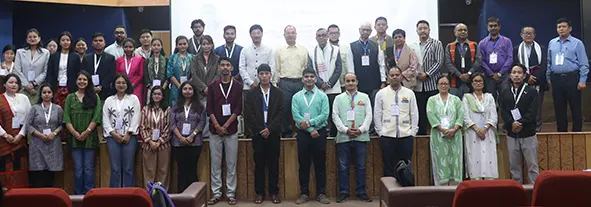
RONO HILLS, 12 Mar: A two-day national seminar on ‘Dynamics of economic development in Northeastern region of India: Present status, emerging issues and future prospects’ got underway at Rajiv Gandhi University (RGU) here on Thursday.
The seminar is being organised by RGU’s economics department’s Centre for Development Studies.
Addressing the inaugural function, former RGU vice-chancellor Prof Atul Sarma said that the Northeastern region of India has huge potential for development, but these are not translated into reality. He said that the Shukla Commission had earlier identified five deficits of development in the region – infrastructure deficit, deficit of fund, deficit of technology, deficit in governance, and deficit in linkage with rest of the country.
“The region is a protected one, and security reason is the prime for infrastructure development,” he said. He stated that, because of strategic location, the region was not considered suitable for setting up of key industries. “The region is suffering from infrastructure deficit as the cost of infrastructure development is four to five times higher in the hilly areas of region as compared to rest of the country,” he added.
Further, with the digitisation of the economy, there are other emerging issues like skill deficiency and skill mismatch in the in the region, leading to growing youth unemployment. Prof Sarma said that the potential in the region has two problems. “It requires huge investment and narrow resource base. Resources are depleting nature, so we need to reinvest the revenue received in creating assets for future generation, but doing so is a challenging task,” he added.
“The states of the region are tiny, except Assam, and so the market size is small, he said. To overcome it, he suggested establishing a “unified Northeastern economy and ensure free flow of goods and labour.” He added that, “in the case of tourism development, there is need to develop circuits covering different states of the region to have a unified market.” He opined that unified market, connectivity improvement and digitisation, supported by appropriate policy can help the region’s economy to grow faster.
RGU Pro-Vice-Chancellor Prof Amitava Mitra delivered the keynote address on sustainable development. He pointed out that sustainable development is essential for the region to maintain a balance between economic development and ecological balance. He said that in 17 goals of sustainable development, most states of the region are performing below the national average. He mentioned that Sikkim is the top performer in sustainable development goals because of organic farming and ecotourism, and advised other states to follow the Sikkim model. He highlighted the potential of the region for achieving sustainable development, such as ecotourism, agriculture, horticulture, floriculture, and hydropower. He called for strengthening infrastructure, promoting ecotourism, and organic farming for achieving the goals of sustainable development.
He stated that the region can be “a global hub of organic mart in the future.
“The region needs to move on new pathways to translate potentials into reality,” he said, and suggested ensuring market linkages, productivity enhancement, institutional support, and inclusive approach.
RGU Vice-Chancellor (i/c) Prof SK Nayak urged the scholars to “put research ideas in a simple way, so that they can be understood by the people at large.” He suggested to the scholars to focus on the parameters of sustainable development and carry out in-depth research to understand the issues related to sustainable development.
RGU Social Sciences Dean Prof Nani Bath said that the growing inequality in the region is mainly due to lack of division of labour, low productivity, and low return, due to lack of knowledge about large-scale farming. He criticised the imitative enterprising in the region and called for innovative practices for development.
Speaking on the land acquisition issues related to development projects, he stated that tribal people are sensitive with regard to their land and culture, “and so the state should take proper concerns of the local people.” He opined that there should be proper rehabilitation, proper compensation, social impact assessment and environmental impact assessment before land acquisition.
RGU Finance Officer Prof Otem Padung called for “balanced development of all the sectors of the economy and balanced regional development, as unbalanced development is not tenable or attractive.”
The inaugural function was attended by deans, heads of departments, officers of RGU, delegates from different universities and colleges of the country, and research scholars.