[ Prem Chetry ]
TAWANG, 16 Apr: A two-day workshop on monitoring threatened mammalian fauna of the Indian Himalayan Region (IHR) concluded at the Indian Institute of Management’s satellite centre here on Thursday.
The training programme on methods of monitoring mammalian fauna of the Himalayas under the National Mission on Himalayan Studies (NMHS)-funded project was organised by Kolkata (WB)-based Zoological Survey of India (ZSI), in collaboration with the state Environment, Forest and Climate Change Department.
The workshop aimed to enhance the capacity of frontline staff, field officers, district administration and local community in monitoring and conserving the rich mammalian biodiversity of the IHR.
The programme emphasised on collaborative conservation, awareness, scientific monitoring, and frontline capacity enhancement to address rising human-wildlife interactions and climate change impacts. It further emphasised the importance of collaborative conservation, scientific monitoring, awareness generation, and capacity building for effective wildlife management in ecologically sensitive landscapes.
The participants were introduced to key threatened mammalian species of the IHR and adjoining landscapes, their ecological roles, emerging threats, and the need for long-term monitoring to inform conservation planning and management interventions.
Earlier, on Wednesday, the inaugural session was attended by Tawang DFO Piyush Gaikwad, who highlighted the importance of scientific monitoring and evidence-based decision-making for wildlife conservation, and emphasised the role of frontline staff in safeguarding biodiversity.
He highlighted the importance of wildlife forensics in controlling wildlife crime, and underscored the need for integrated and participatory approaches to conservation, stressing that collaboration between the Forest Department, research institutions, and local communities is essential for sustaining biodiversity in the region.
Gaikwad stressed on collaborative approach between the Forest Department and the ZSI for better conservation and management of wildlife in Tawang’slandscape.
ZSI Scientist-E Dr Lalit Kumar Sharma provided an overview of the of the workshop. He highlighted the objectives, scope, and conservation significance of the project and discussed major threats faced by Himalayan and associated mammalian species.
Dr Sharma emphasised that several key mammalian species are experiencing rapid population declines and require immediate scientific attention and coordinated conservation action at both regional and national levels. He also highlighted the role of the Forest Department in biodiversity conservation and management at the regional level.
The training programme included technical sessions and hands-on demonstrations focusing on modern tools and techniques for mammal monitoring.
Research associate Dr Amira Sharief delivered a lecture on the importance of wildlife corridors and landscape connectivity, followed by a presentation by ZSI research associate Dr Ritam Dutta on introduction to tools and techniques used for monitoring mammalian fauna.
Dr Dutta also delivered a presentation on the use of remote sensing and GIS in wildlife conservation. A practical hands-on training and field demonstration session was conducted by the ZSI team, during which the participants were trained in the use of camera traps, GPS and compass, trail surveys, and vegetation sampling techniques.
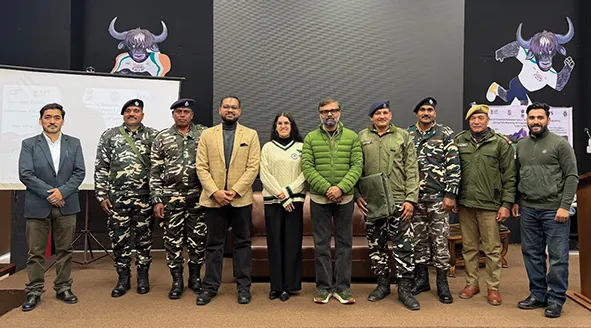
The programme witnessed the participation of over 40 stakeholders, such as officials and staff of the Tawang Forest Division, officials of the 38th Bn SSB Tawang, officials of the Horticulture Department, Jang police officers, local NGOs (Monyul Society, Jeo aur Jeene Do society, Being Monpa Foundation), president and members of the All Tawang District Students’ Union,all gaon buras, and people from Bletting village.
All speakers emphasised the critical importance of long-term monitoring for understanding population trends, identification of biodiversity corridors, mitigating human-wildlife conflict, habitat use, and threats to mammalian species. The role of genetics-based research and landscape-level studies was also highlighted as essential for understanding species connectivity, genetic diversity, and climate resilience.
On day one, the training coordinator spoke on collective commitment to integrate scientific knowledge, field-based practices, and institutional collaboration for strengthening wildlife conservation efforts in Tawang and the IHR.
The second day featured a lecture by ZSI Joint Director Dr Lalit Kumar Sharma, who presented a talk on ‘Forensics in wildlife crime investigation’. Dr Sharma emphasised that illegal wildlife trade ranks as the third most significant criminal enterprise worldwide, following drug and arms trafficking, and advocated enhanced law enforcement measures to combat these offences.
The event included a presentation by research associate Dr Kalzang Targe, who emphasised “the significance of feeding ecology in conservation and management of wild species in the IHR,” and reviewed case studies on the Himalayan ibex from prior initiatives in the Himalayas.
Dr Vineet Kumar delivered a presentation on ‘Human-wildlife conflict and its mitigation measures’, during which he examined how conflicts between humans and wildlife endanger species and how human alterations affect the natural habitats of the Himalayan black bear.
All speakers at the event emphasised the importance of long-term species monitoring in informing conservation efforts, and praised the programme for providing frontline personnel with vital technical skills.
The significance of genetics-based research was emphasised as essential for comprehending species’ climate tolerance, genetic diversity, and population connectedness.