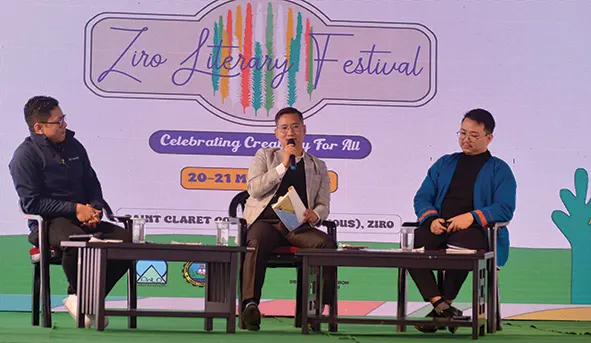
ZIRO, 21 Mar: The Ziro Literary Festival, jointly organised by PWLO Entertainment and Saint Claret College, Ziro (SCCZ), concluded on Saturday after two days of vibrant literary and cultural engagements.
Speaking during the valedictory function, Tourism Secretary Ranphoa Ngowa encouraged students and participants to be fearless in expressing themselves through various art forms.
He urged them to use creativity as a means to heal the world, and emphasised that creativity should not become a burden but remain a free and liberating process. He advised the participants to become voices that shape the future.
In his concluding remarks, Fr Allwyn Mendoz said that the festival was organised to provide a platform for local voices and emerging talents. He noted that “the true success of the festival lies in the learning outcomes that can bring positive change in society.”
The concluding day featured a series of engaging sessions that brought together writers, journalists, filmmakers, and students. A panel discussion on ‘Who owns a language? Community, script and the question of correctness’ saw Dani Sulu, Gyati Rana, and Tage Kanno in conversation with Moji Riba. The discussion explored the questions of linguistic identity and ownership.
Another session, ‘Food as memory and modern identity’, featured Aditi Banerjee, Vishal Langthasa, and Karma Paljor, who reflected on the intersections of food, culture, and contemporary identity.
The festival also hosted a poetry reading and conversation with Moge Basar and Taro Sindhik, moderated by Ranju Dodum. In a discussion titled ‘Across cultures: Expanding the Indian literary imagination’, Sayantan Ghosh and Taro Sindhik engaged in dialogue with Karma Paljor on evolving literary narratives across cultures.
A film screening of When the Mist is Lifted, directed by Moji Riba, added a cinematic dimension to the festival.
In addition, a workshop on ‘Making music with AI’ was conducted by Anup Kutty, introducing participants to the intersection of technology and creative music-making.
To mark the World Poetry Day, SCCZ’s English department, in association with its mass communication department, organised a special programme during which a collection of poems written in local dialects was presented in an audiovisual format, celebrating linguistic diversity and indigenous expression.